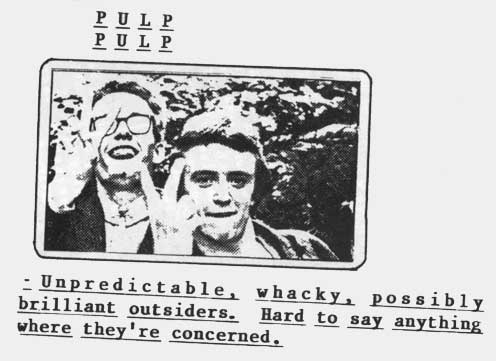
«As a yardstick, I suppose you could see our inclusion on Your Secret’s Safe With Us, the only Sheffield group on the album, as fairly indicative of our development.» Jarvis Cocker, Pulp’s supremo, is almost shouting down the phone, and I wished I’d never asked him to convince me just why I should travel to Sheffield to find out about the poppier side of life there After all, there now seem to be an altogether exaggerated number of hopeful pretenders appearing every week, in the wake of the Human League’s success. But after listening to the deliciously innocent pop session they produced for John Peel and finding myself unable to resist the track they have produced for the afore˗mentioned LP (which is the successor to the diversely genial Hicks From The Sticks), how could I resist their invitation to meet?
Pulp proved to be a most bizarre visual proposition. Fronted by Jarvis, the tallest teenager I’ve ever shook hands with, they flocked round me like curious vultures eyeing up a prey. I’m haunted by splashes of wild colour, off˗beat clothes and hair and an underlying purity which just doesn’t seem to fit. Pulp tell me who they are too quickly; they don’t want to spend too much time on such tedious formalities. But for our record; here’s their list: Jarvis (vocalist, guitarist and main lyricist), Peter Dalton (synthesizer), Wayne Furniss (drums) and Jamie Pinchbeck (bass). Innocence. Pulp admit to a basic love of everything pulpy. If it’s pure, unadulterated, lovable or poppy they’ll go for it, they tell me. But they’re not naively stupid.
«Yeah, we’ve learned that innocence doesn’t always click when you’re involved with something like being in a band, which will ultimately become marketable» Jarvis explains. «Like when we played our first real gig at the local arts centre, we thought the future would be super fine, just because we had our own flashy dressing room. We soon hit the ground during the following two weeks when we had to play pubs like the Hallamshire, with shoe box rooms to get ready in.»
Peter tells me of Pulp’s basic ambition. «We’d like to see pop getting back to an innocent, trashy, disposable medium, which allows more time for humour and cuts down on the gloom.» Jarvis quickly intervenes: «But just because we’ve got a sense of humour doesn’t mean that we want to be seen as some kind of ‘joke’ band. «l just don’t want to write about kicking the Russians out of Poland» he continues. «l’d rather that be said from a political platform than having somebody on a music stage saying it. We’re simply not interested in either sloganeering or coming on all pretentious and illegitimately boastful.» What slant do you actually write from/on, then?
«Well, at bottom l suppose l write what you’d call love songs» says Jarvis.« It’s universal, probably the main emotion in life. So if I can say something politic about love everyone can at least relate to it.» How did the Peel session come about? «He was appearing at some unemployment benefits at the Iocal Poly when we just approached him with a tape of ours» says Jamie. «He said he’d listen to it on the way home, we said ‘liar’, but the week after we got a call from his producer asking us to do the session.» Pulp are solid in their defence when I suggest that Peel’s selection criteria have shown glaring holes over the last year. «Alright, so perhaps his show has gone off the boil lately, but it’s hardly his fault that there’s much to choose from, but not much that’s any good» Peter shouts at me. «Put it this way; without him we’d probably not exist and you’d not be here.»
We move sideways to discuss the less controversial subject of Pulp as a live commodity. «We see ourselves very much as a challenging live group» Jarvis says. «I know it sounds a real cliche but we’d really like people to move away from their preconceptions. We find it amusing to get up on a stage six inches above everyone else. They’re expecting something abnormal from us, so we just try to make them see that they shouldn’t do. «They’re as important as us; together we can have a real fun party, but if they won’t play we find it difficult to motivate ourselves.»
Pulp live is a carnival of lunacy, probably the future focus of live performance in essence: humour, participation, letting your hair down, but backed up by a whirling synthesizer pop music which ultimately keeps the party punching. «You’re dead right, we are interested in performance˗art» Jarvis tells me. «We want to bring fun back into pop but not facile fun, like driving cars into swimming pools. That’s stupidly excessive.» Pulp have confident ideas about their future. «I’m wary of signing to a big company and then releasing a single» Jarvis explains.
«l think it’s better for credibility to release a single on an independent first» he adds, «then you can build from a good base, with people looking at you with that important initial respect.» Apparently, Armageddon are already giving some thought to a possible deal and Pulp are relishing
Pulp are a quite different proposition. While on the surface they may appear to be a more conventional group than Danse Society, in their own subtle way they kick far harder against the established rock mores. Danse Society are humourless and superficial. Pulp are funny and sincere. There’s reason behind their lunacy. They ridicule the idea that pop music can have more than momentary impact, so pose tongue in cheek and take the piss, mainly from themselves. Singer Jarvis Cooker introduces songs in precisely the same tones of resigned existentialism as John Peel, but in their changing moods manages to scream lyrics with a manic and uncool devotion. In fact it was a bad night for Pulp. To appreciate their finer points and realise they’re more than just another pop group one needs to observe at close range and hear the words, which was practically impossible in the prevailing atmosphere. Even so the audience loved them and demanded an encore. A Pulp LP would be wonderful though I don't know if anyone would buy it. Though ‘trash’ is their favourite word and disposability their creed I'd hate to think of Pulp remaining unknown only for somebody compiling an album of 80’s trivia to rediscover them in the year 2000 and wonder why they weren’t famous.